Five terms of being sure

We had our Phil.

He says listening matters more than talking. Here are the times Vermonters told him he had something wrong, and what he did next. Each one links to the reporting.

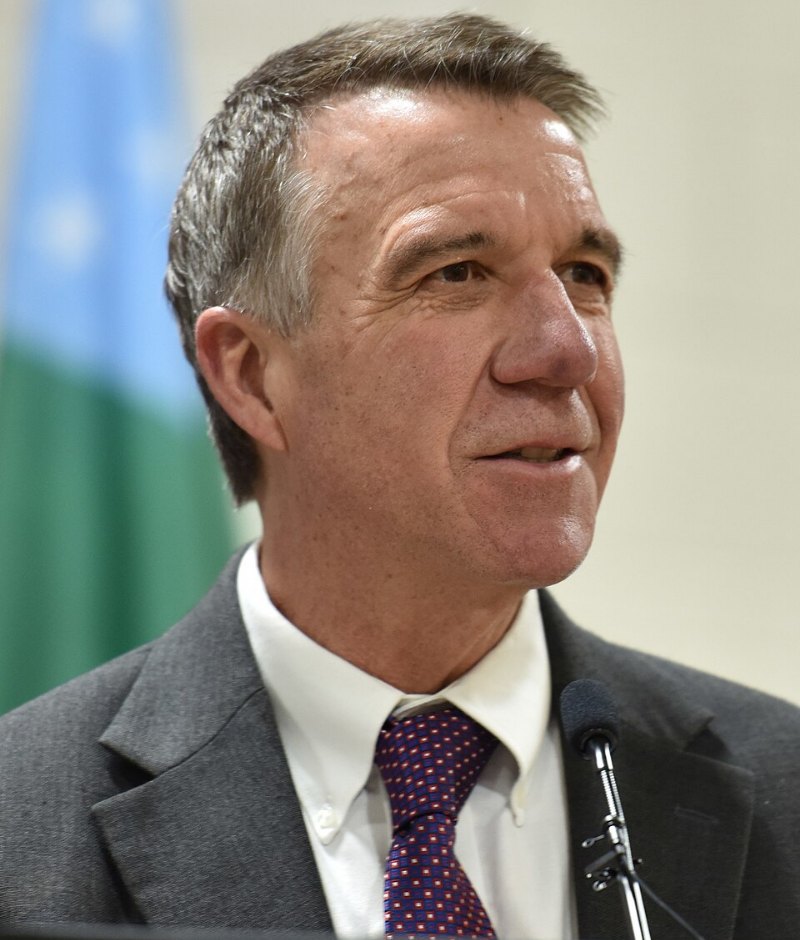
Governor Phil Scott speaking at a lectern
Fig. 1: The incumbent, certain
<50%

His job approval in two late-September polls, the first time it has fallen below half. One had his challenger ahead.

Boston Globe
5,000+

Vermonters heard by his school redistricting task force, which found overwhelming opposition to forced mergers.

North Star Monthly
0.6%

Share of Vermont's private-sector workers whose employers had signed them up for his voluntary paid leave plan by April 2026, according to advocates.

Vermont Paid Leave Coalition
2

Debates with his challenger, on Oct. 21 and Oct. 28. In late September the Rutland Herald could find only one.

WCAX
In his words

“Listening is more important than talking; and actions speak louder than words.”

Phil Scott has been governor since 2017. He holds public hearings and appoints task forces, and when Vermonters tell him something he didn't want to hear, he tends to veto it or wave it off.

A majority of Vermonters polled wanted paid family leave, and he vetoed it twice. His school redistricting task force heard from more than 5,000 people and didn't draw the district maps it was supposed to. He called that "a political strategy to preserve the old system." When state workers beat his return-to-office order at the labor board, he took it to the Vermont Supreme Court and won.

Every factual claim below links to its source. Entries marked Opinion are our opinion.

The record

Where he was wrong

The listening tour he stopped listening to

Didn't listen

Created a Climate Action Commission and sent it on a four-stop public listening tour.

Halfway through the tour, VPIRG says, he waved off the testimony in a social media post and promised to veto what speakers were asking for: a price on carbon pollution, with the money returned to Vermonters.

1 source

Paid family leave, vetoed twice

Didn't listen

Vetoed paid family and medical leave bills in 2018 and 2020. In 2020 he said his voluntary plan would do it "more efficiently, affordably and quickly, without a $29 million payroll tax."

A 2020 VPR-Vermont PBS poll found 56% support for paid family leave even if it meant higher taxes. In April 2026, advocates told lawmakers that 79 of roughly 17,000 private employers had signed up for the voluntary plan, covering about 1,800 workers, or 0.6% of the private-sector workforce.

4 sources

"They failed"

Didn't listen

When his school redistricting task force recommended voluntary mergers instead of drawing new maps, he said its members "didn't fulfill their obligation."

The task force had heard from more than 5,000 Vermonters and found overwhelming opposition to forced consolidation. The research it reviewed showed that larger districts don't reliably cost less.

2 sources

Forced mergers, or no budget

Backed down

Opened the session promising to veto the state budget unless lawmakers passed mandatory school district consolidation. In his State of the State he called the task force's failure to produce maps "a political strategy to preserve the old system."

The House Speaker said voters wanted property tax relief but weren't willing to give up control of their local schools to get it. In late May he dropped the demand, and the final law leaves mergers voluntary.

5 sources

Return to office, by order

Didn't listen

Ordered state employees back to the office at least three days a week.

The state employees' union won before the Vermont Labor Relations Board in April. He appealed, saying "the vast amount of Vermonters are saying, 'why not five?'" In September the Vermont Supreme Court unanimously sided with him, and the order is back in force.

2 sources

Two debates, late

Didn't listen

His challenger pressed him a few times to debate more. He said "No thanks."

In late September the Rutland Herald could find only one scheduled debate and wrote, "Refusing to engage feels either arrogant or out of touch." As of Oct. 12 there are two: Oct. 21 on Vermont Public and Oct. 28 on WCAX.

3 sources

The polls

Ruled against

Won his last three races by more than 40 points and was long called the most popular governor in America.

Two polls released in late September found, for the first time, that fewer than half of Vermonters approve of his job performance. One had his challenger ahead by 6 points.

2 sources

Not saving us money

Opinion

He runs on affordability. By late 2025, education property taxes had risen more than 40% in five years, a figure he cites himself when he argues for school reform.

Two letter writers in the Brattleboro Reformer argue that this happened on his watch and that he won't tax out-of-state millionaires with second homes. They conclude that he "is not saving us money."

3 sources

We had our Phil.

Five terms was our fill. Vermonters have been telling him things since 2017. The election is November 3.